Showing posts with label reverse. Show all posts

Sunday, January 25, 2015

DNS reverse proxy

I have a server with a single IPv4 and I want to run two DNS servers:
  • one to serve zones like stalkr.net - if you recall, I like PowerDNS;
  • another one for tunneling - I like dns2tcp (TCP level), another good one is iodine (IP level).
Problem: I looked a bit but none of the DNS server software I've seen support forwarding queries that aren't for them to another server. Basically what I need is a reverse proxy that looks at the DNS query, and route it based on the name. It's the same as an HTTP reverse proxy that looks at the Host field to proxy the request to another server. I tried to hack with resolvers and stub/forward zones but it didn't work.

So I made my own dns-reverse-proxy in just a few lines of Go, using a fully featured DNS library. It's running smoothly, if you have the same need feel free to use it!

Friday, June 17, 2011

Hack in the Box Amsterdam 2011 CTF

May 19th-20th was Hack in the Box Amsterdam 2011 security conference in the Netherlands, also holding a CTF. To participate, you had to qualify to one of the two qualification rounds that involved web security and reverse engineering.

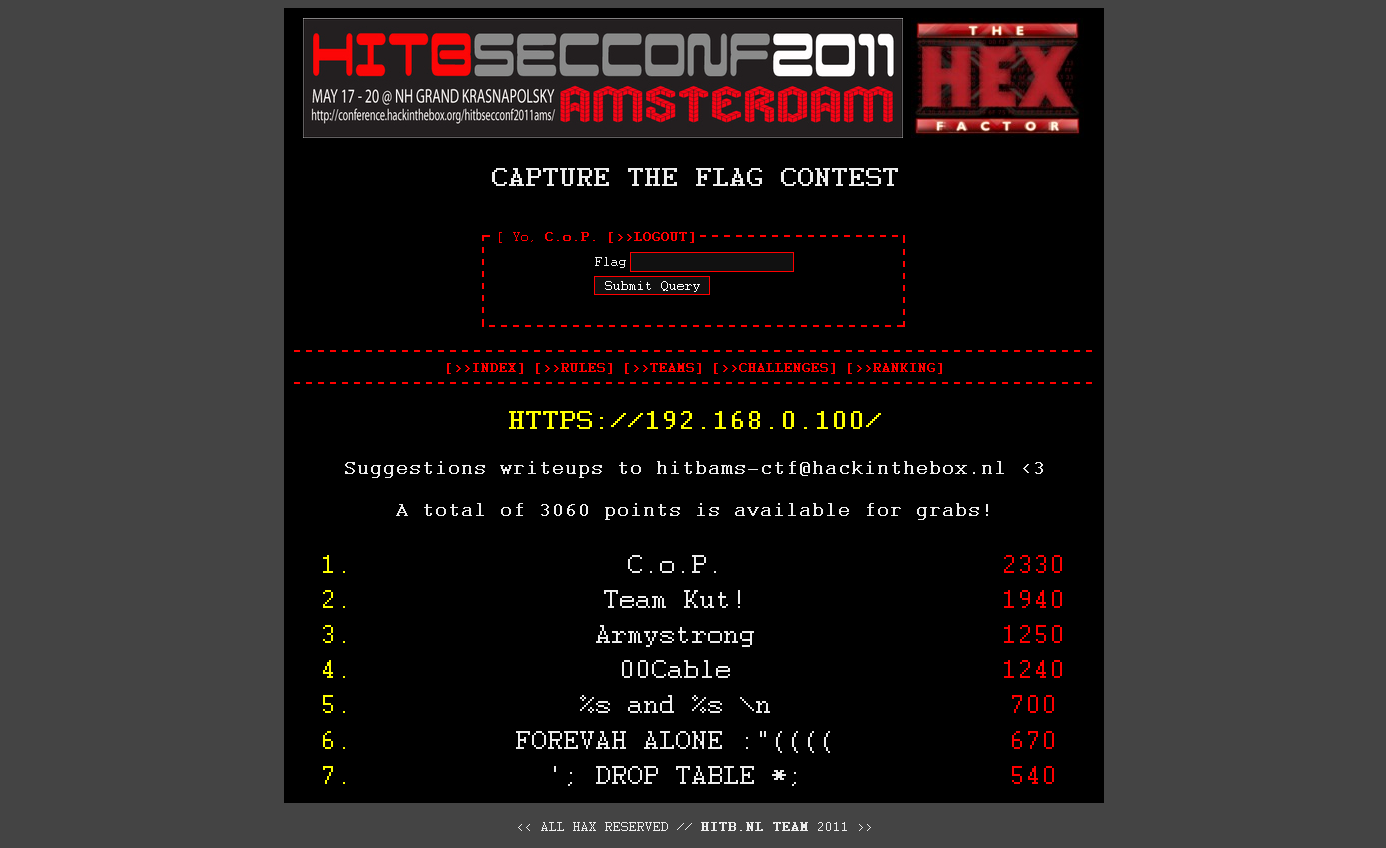
We passed qualifications with team CoP so I went there with teammate sh4ka to play, and we were lucky enough to end in the first place. Congrats to all teams, it was intense! In addition to a nice HITBSecNews jacket, staff generously awarded us two training and conference tickets to HITB Kuala-Lumpur (Malaysia) 2011. So, see you there :)


final scoreboard

Wednesday, March 09, 2011

Insomni'hack GPGPU reversing

One of the reversing challenges was exotic: we were given a ciphertext (ohv'c~f3ehnw4byzzky), a GPGPU file (kernel.bin) of the encryption routine, and the Instruction Set Architecture (ISA) of this GPU.

Since I have never played with GPGPUs (code/assembly/whatever), it seemed hard at first glance. But actually not! Open kernel.bin and see that there's some kind of disassembly. Good! And pretty small, roughly 80 lines of code.

I will explain how I reversed it and reimplemented it in Python to have the same encryption routine, discovered that it was also the decryption routine, and just run it against the ciphertext to obtain the plaintext.