Again this year was ShmooCon's Ghost in the Shellcode warm-up round or Teaser (@ShellGhostCode). Congrats to Eindbazen for winning!
There was three challenges: crypto (Tel Aviv), crackme (AL's revenge) and exploitation (Hackquest). You will notice strong references to Hackers (1995) movie. Write-ups can be found on FixMe wiki, Leet More blog or Eindbazen blog.
Sunday, January 08, 2012

Wednesday, August 31, 2011
HSTS preloading, public key pinning and Chrome
I recently discovered Chrome's net-internals. Among other interesting things, there is a tab about HTTP Strict Transport Security (HSTS). Also, introduced with version 12/13, Chrome now has HSTS preloading and public key pinning. These two features helps improve online security:
- HSTS preloading: browser already knows if a site has to be contacted via HTTPS only. For instance, it ensures users go to https://site even if they type http://site. This protects against MITM attacks when reaching http://site for the first time (see how sslstrip strips the "s" of https).
- public key pinning: certificate chain must include a whitelisted public key. For instance, it ensures only whitelisted Certificate Authorities (CA) can sign certificates for *.example.com, and not any CA in your browser store.
Friday, July 08, 2011
Twitter Archiver
Twitter is great to get and share information, quickly. But it is all web 2.0 and you cannot use a simple cat or grep to view or search your tweets. I would like to have tweets saved in simple text format: date, user, text. Also, I would like a simple program to give me the list of followers/following of a user.
Fortunately, Twitter provides a web API and people started to implement it in different languages, like Mike Verdone (@sixohsix) and his great Python Twitter Tools.
So here comes twitter-archiver and twitter-follow, python programs added to Python Twitter Tools to archive any public timeline of tweets in simple text format and to view the list of following/followers of a user.
Fortunately, Twitter provides a web API and people started to implement it in different languages, like Mike Verdone (@sixohsix) and his great Python Twitter Tools.
So here comes twitter-archiver and twitter-follow, python programs added to Python Twitter Tools to archive any public timeline of tweets in simple text format and to view the list of following/followers of a user.
Friday, June 17, 2011
Hack in the Box Amsterdam 2011 CTF
May 19th-20th was Hack in the Box Amsterdam 2011 security conference in the Netherlands, also holding a CTF. To participate, you had to qualify to one of the two qualification rounds that involved web security and reverse engineering.
We passed qualifications with team CoP so I went there with teammate sh4ka to play, and we were lucky enough to end in the first place. Congrats to all teams, it was intense! In addition to a nice HITBSecNews jacket, staff generously awarded us two training and conference tickets to HITB Kuala-Lumpur (Malaysia) 2011. So, see you there :)

final scoreboard
We passed qualifications with team CoP so I went there with teammate sh4ka to play, and we were lucky enough to end in the first place. Congrats to all teams, it was intense! In addition to a nice HITBSecNews jacket, staff generously awarded us two training and conference tickets to HITB Kuala-Lumpur (Malaysia) 2011. So, see you there :)
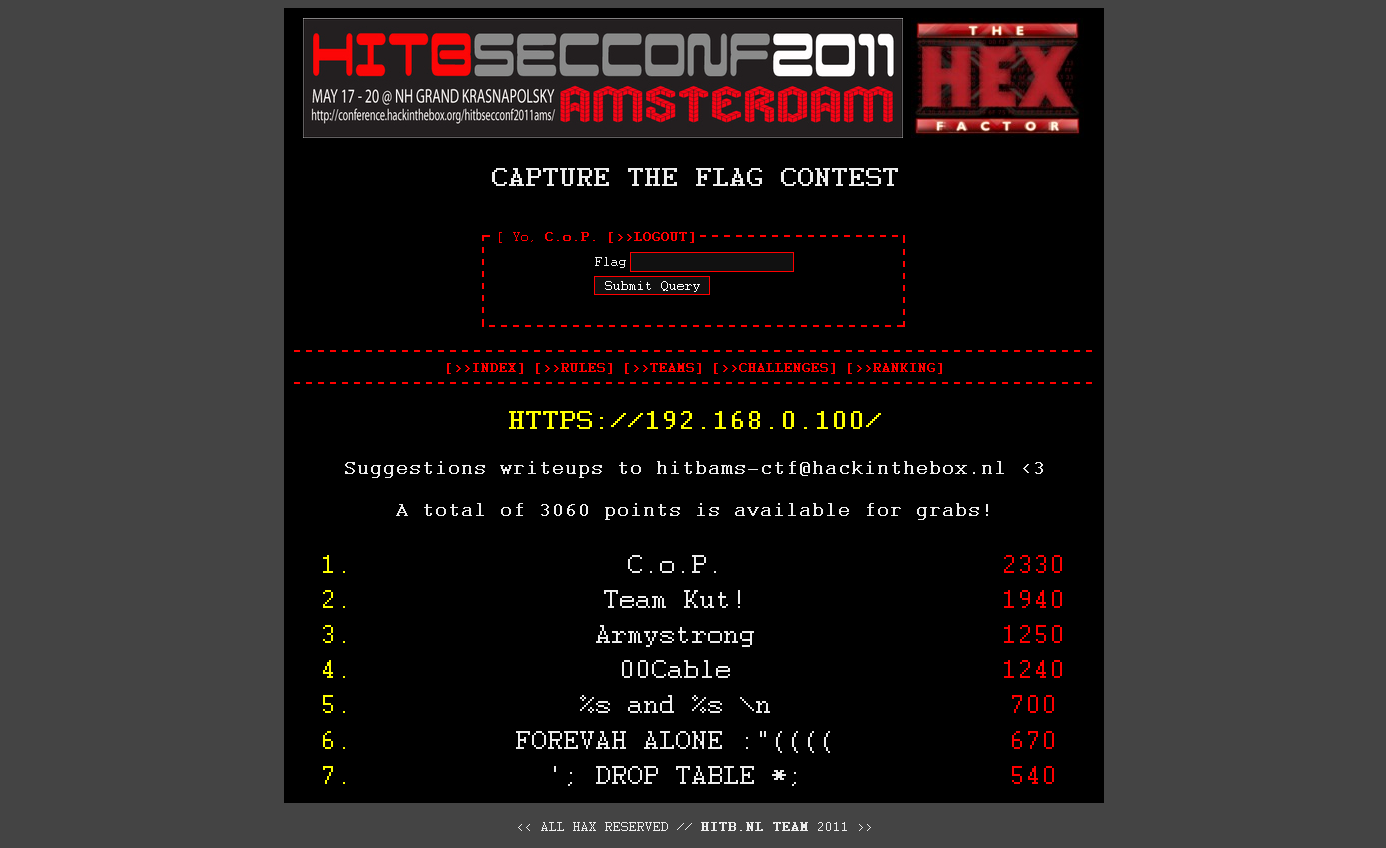
final scoreboard
Saturday, May 07, 2011
Ubuntu 10.10->11.04 encrypted LVM fail, rebuilding initramfs, rdinit
One of my workstations was an Ubuntu 10.10 on an encrypted LVM. I decided to upgrade to 11.04 and was unable to boot, falling back to initramfs busybox shell.
If you are not familiar with this kind of setup, it basically works with:
If you are not familiar with this kind of setup, it basically works with:
- a non-encrypted /boot with kernel and initramfs
- initramfs contains required modules (aes, lvm, etc.) and a few scripts to mount the filesystem: in this case, a script to ask for the password, decrypt the LVM and mount the root filesystem
Friday, April 29, 2011
pCTF 2011 #18 A small bug
Challenge #18 "A small bug" was a common TOCCTOU bug very interesting to exploit reliably.
@hellman already did a write-up on this challenge. His exploit reads the file name on stderr and hopes to win the race on symlink creation. But actually there is a way to win the race every time! Let's see that.
@hellman already did a write-up on this challenge. His exploit reads the file name on stderr and hopes to win the race on symlink creation. But actually there is a way to win the race every time! Let's see that.
Wednesday, April 27, 2011
pCTF 2011 #19 Another small bug
Challenge #19 "Another small bug" was a stack-based buffer overflow.
Djo (@shell_storm) has already published a write-up (english) on Nibbles' blog, as well as @hellman on Leet More's blog, and Agix (@Agixid) on shell-storm. Just like hashcalc1 or hashcalc2, there was no NX. However, ASLR was enabled. Djo and hellman both used a big nopsled + brute-force to circumvent ASLR, Agix used a nice ret2ret, while I chose ROP to mmap rwx. Good thing is that it would also have worked if NX had been effectively enabled.
Not familiar with ROP? Have a look at the references posted on this exploit writing tutorial by @corelanc0d3r.
Djo (@shell_storm) has already published a write-up (english) on Nibbles' blog, as well as @hellman on Leet More's blog, and Agix (@Agixid) on shell-storm. Just like hashcalc1 or hashcalc2, there was no NX. However, ASLR was enabled. Djo and hellman both used a big nopsled + brute-force to circumvent ASLR, Agix used a nice ret2ret, while I chose ROP to mmap rwx. Good thing is that it would also have worked if NX had been effectively enabled.
Not familiar with ROP? Have a look at the references posted on this exploit writing tutorial by @corelanc0d3r.
Tuesday, April 26, 2011
pCTF 2011 #26 Hashcalc2
pCTF 2011 #22 Hashcalc1
Challenge #22 "Hashcalc 1" was binary exploitation over the network.
A good write-up is already available on sleepya's blog. He made an exploit bypassing any ASLR/NX using ROP.
However, NX was not enabled on the wargame machine... Organizers thought they did, but it was not effective :( Good for us it means only ASLR, and the binary was not even PIE. One could exploit it quickly by writing a shellcode in the GOT, let's see that.
A good write-up is already available on sleepya's blog. He made an exploit bypassing any ASLR/NX using ROP.
However, NX was not enabled on the wargame machine... Organizers thought they did, but it was not effective :( Good for us it means only ASLR, and the binary was not even PIE. One could exploit it quickly by writing a shellcode in the GOT, let's see that.
pCTF 2011 #32 That's no bluetooth
The only networking problem at pCTF 2011 was unusual because it involved ZigBee, based on IEEE 802.15.4.
Context
We captured this network traffic from outside of an AED employee's home.

Decrypt it and find the key.

Update: Our operatives were able to decrypt packet #18 in the capture file.

The decrypted data is 18060a0700421a63343a636f6e74726f6c345f73723235303a43342
d53523235300400420830332e30312e3534050020040600213c00
or (printable text only) Bc4:control4_sr250:C4-SR250B03.01.54 !<

If you aren't getting the correct values, make sure your keys are correct,
and that they are entered correctly. Keep in mind bits sometimes flip when
transmitting signals wirelessly.
download file
Subscribe to:
Posts (Atom)